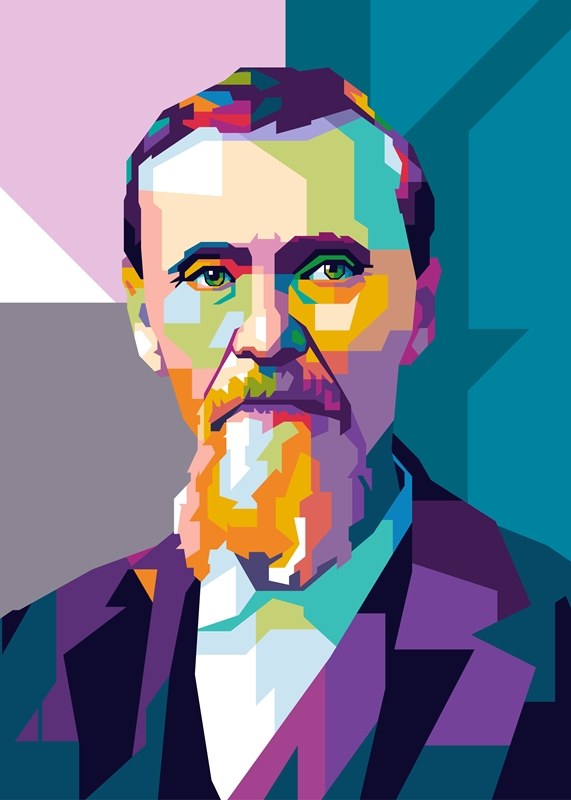
The foundations of osteopathy
A Civil War surgeon who lost three children to meningitis, Still refused to accept that medicine had no better answers. What he developed in 1874 changed healthcare forever.
"The object of the physician is to find health. Anyone can find disease."
Andrew Taylor Still · Founder of Osteopathy · 1828–1917
The man behind the medicine
Andrew Taylor Still was born in 1828 in Virginia, the son of a Methodist minister and physician. He grew up learning medicine from his father, eventually serving as a surgeon during the American Civil War, an experience that exposed him to the brutal limitations of medicine at the time.
The defining moment of his life came in 1864, when three of his children died from spinal meningitis despite receiving the best medical care available. Devastated and disillusioned, Still began to question the foundations of conventional medicine, including the widespread use of drugs he believed often caused more harm than good.
On 22 June 1874, he formally announced the discovery of osteopathy, a philosophy of medicine built on the idea that the body has an innate capacity to heal itself when its structure is functioning correctly.
1828
Born in Lee County, Virginia
Son of a frontier physician and minister, exposed to medicine from an early age.
1861–1865
Civil War surgeon
Witnessed the devastation of battlefield medicine and grew increasingly critical of prevailing treatments.
1864
Personal tragedy
Three children died from spinal meningitis, the catalyst for his radical rethinking of medicine.
1874
Osteopathy founded
Still formally announced his new system of medicine, rooted in the relationship between structure and function.
1892
First school of osteopathy
The American School of Osteopathy opened in Kirksville, Missouri, the world's first osteopathic institution.
1917
Legacy secured
Still died having established osteopathy as a recognised healthcare profession practised worldwide.
The philosophy
Still's original philosophy can be distilled into four core principles that remain the foundation of osteopathic practice to this day, in Blackpool, across the UK, and around the world.
The body is a unit
The person is a complete, integrated unit of body, mind and spirit. No single part can be treated in isolation, everything is connected. A problem in the lower back may be influenced by posture, breathing, stress or movement patterns elsewhere in the body.
Structure and function are interrelated
The structure of the body, its bones, muscles, joints, connective tissue, directly influences how it functions. When structure is compromised, function is affected. Restoring optimal structure supports the body's ability to work as it should.
The body has self-healing capacity
The body possesses its own self-regulating and self-healing mechanisms. The role of the osteopath is not to fix or cure, but to remove the barriers that are preventing the body from doing what it is designed to do.
Rational treatment is based on these principles
Treatment must acknowledge all three principles above. Care is not applied as a generic protocol but as a thoughtful, individualised response to the unique circumstances of each patient, their history, their body, their life.
For healthcare professionals
Osteopathy has moved well beyond its 19th century origins. Today's practice is grounded in contemporary musculoskeletal science, neurophysiology and evidence-based clinical reasoning. Each card below links directly to the relevant evidence.
NICE guidelines (NG59) recommend manual therapy, including osteopathic treatment, as part of a package of care for low back pain, alongside exercise and psychological support where appropriate.
Manual therapy techniques used in osteopathy have been shown to activate descending pain inhibition pathways, reduce central sensitisation and modulate nociceptive processing, effects that extend well beyond the purely mechanical.
Systematic reviews support osteopathic manipulative treatment for low back pain, neck pain and musculoskeletal conditions. The Cochrane Library holds several relevant reviews on manual therapy effectiveness.
Osteopathy is statutorily regulated in the UK under the Osteopaths Act 1993. All practising osteopaths must be registered with the General Osteopathic Council and meet ongoing CPD requirements.
We welcome referrals from GPs, physiotherapists and other healthcare professionals. Our osteopaths provide:
For referral queries, clinical questions or to discuss a patient, contact David or Reece directly.
Osteopathy is appropriate for a wide range of musculoskeletal presentations:
Osteopathy in 2026
Still's founding principles remain remarkably relevant. Modern osteopathy has evolved to incorporate contemporary understanding of pain science, neurophysiology and evidence-based practice, while retaining its founding commitment to treating the whole person.
In the UK, osteopathy is one of a small number of complementary healthcare professions to hold statutory regulation, meaning patients can be confident that their osteopath has met rigorous education, clinical and ethical standards.
At Osteopath Blackpool, we are proud to carry Still's founding philosophy forward, combining his whole-body approach with modern, evidence-informed practice to help patients across the Fylde Coast live pain-free, active lives.
Osteopathy by numbers
150+
Years of osteopathic practice
5,500+
Registered osteopaths in the UK
30,000
Patient consultations per week in UK
1993
Year of statutory regulation in UK
Over 150 years of evolution. One founding principle remains, your body has the capacity to feel better.